Scoliosis creates a spine that curves sideways rather than running straight. This lateral curvature changes how massage chair rollers contact your back. Standard roller tracks follow a path designed for typical spines. When your spine deviates from that path, rollers miss some areas and apply unwanted pressure to others.


The right massage chair provides meaningful relief for scoliosis patients. Muscle tension around curved segments responds well to targeted massage. Adjustable depth, manual spot control, and air compression systems accommodate non-typical spinal anatomy. This guide covers how scoliosis affects chair selection, which features matter most, and the best products for curved spines.

Table of Contents
- How Scoliosis Changes Your Massage Needs
- Types and Severity of Scoliosis
- Essential Features for Scoliosis Users
- Best Massage Chairs for Scoliosis
- Comparison Table: Massage Devices for Scoliosis
- Using a Massage Chair Safely with Scoliosis
- When to Avoid Massage Chairs
- Massage Pads Versus Full Chairs for Scoliosis
- Frequently Asked Questions
- Conclusion
How Scoliosis Changes Your Massage Needs
The Muscle Imbalance Problem
Scoliosis creates predictable muscle imbalances throughout your back. Muscles on the concave side of the curve shorten and tighten chronically. Muscles on the convex side stretch and weaken over time. This imbalance creates tension patterns that cause more daily pain than the curve itself.
The paraspinal muscles along the spine bear the heaviest burden. The quadratus lumborum on one side works harder than the other. Shoulder muscles compensate for uneven rib cage positioning. These compensatory patterns create widespread tension that massage addresses effectively.
Roller Path Challenges
Standard massage chair rollers travel along tracks designed for straight spines. The S-track follows the natural front-to-back curvature from neck through lower back. The L-track extends under the glutes. Neither design accounts for lateral deviation.
For more information, check out our guide on Best Massage Chairs for Lower Back Pain.
When your spine curves sideways, rollers may travel beside the vertebral column rather than along it. They apply pressure to one side while barely contacting the other. Prominent curve areas receive uncomfortable concentrated pressure. The chair works against your anatomy instead of with it.
Body Scanning Limitations
Body scanning technology detects shoulder height and general spine position. Most systems assume bilateral symmetry. They detect vertical landmarks but miss lateral curvature entirely. The scan reports a straight spine regardless of actual curvature.
This means automated programs designed from scan data may target incorrect positions for scoliosis users. Manual control and adjustable settings matter more than sophisticated scanning for curved spines.
Types and Severity of Scoliosis
Idiopathic Scoliosis
Idiopathic scoliosis has no identified cause and represents 80 percent of cases. It typically develops during adolescence. Curves range from mild to severe. Most adults with idiopathic scoliosis have stable curves that respond well to massage therapy.
Degenerative Scoliosis
Degenerative scoliosis develops in adults from disc and joint deterioration. This form typically appears after age 50. The curves progress gradually and often cause significant back pain. Massage helps manage the muscle tension that accompanies progressive degeneration.
Curve Severity and Massage
Mild curves under 25 degrees generally tolerate standard massage chairs well. The lateral deviation stays small enough that rollers still contact the spine effectively. Most mild scoliosis patients use massage chairs without major modifications.
Moderate curves between 25 and 40 degrees require more adjustable chairs. Roller width and depth settings become important. Manual spot massage helps target specific tight areas that automatic programs miss.
Severe curves above 40 degrees present the greatest challenges. Bony prominences may be sensitive to roller pressure. Significant asymmetry makes standard roller paths ineffective. Air compression and massage pads often work better than roller-based systems for severe curves.
Essential Features for Scoliosis Users
3D and 4D Depth Adjustment
Depth adjustment allows rollers to extend or retract during operation. For scoliosis users, this means rollers can back off over sensitive curve peaks and press deeper into tight muscle tissue. The Alfine A688 uses both 4D and 3D mechanisms for maximum depth control.
Standard 2D rollers travel at fixed depth along their track. They cannot adapt to the varying terrain a curved spine presents. The depth adjustability of 3D and 4D systems makes a significant difference for non-typical spinal anatomy.
Manual Spot Massage
Spot massage concentrates treatment on specific points rather than following preset paths. Scoliosis users direct rollers to their actual tight spots instead of relying on programs designed for straight spines. This feature transforms massage chair effectiveness for curved spines.
Wide Roller Width Adjustment
Adjustable roller width helps accommodate spines that curve away from center. Wider settings catch portions of the spine that narrower settings miss. Some chairs allow side-to-side adjustment that tracks asymmetric anatomy better than fixed positions.
Air Compression Systems
Airbags compress from the sides rather than traveling along a track. This avoids the roller-path problems that scoliosis creates. Comprehensive airbag systems in the shoulders, back, arms, and legs provide massage without tracking issues.
For more information, check out our guide on Best Zero Gravity Massage Chairs.
The Osaki Vibe 4D features 32-cell full-body air massage. The distributed compression provides even treatment regardless of spinal alignment. Many scoliosis patients find airbag massage more comfortable than roller massage.
Heat Therapy
Chronically tight muscles around scoliosis curves respond well to heat. Warmth increases blood flow, relaxes shortened muscle fibers, and reduces stiffness. Heat provides standalone relief on days when mechanical massage feels too intense.
Multiple Massage Techniques
Different areas of a curved spine respond to different techniques. Kneading works well on tight concave-side muscles. Gentle rolling suits sensitive convex-side tissues. Tapping stimulates circulation without deep pressure. Technique variety lets you customize treatment for each area.
Zero Gravity Positioning
Zero gravity recline distributes body weight evenly across the entire chair surface. This positioning reduces pressure on any single vertebral segment. Scoliosis patients with pain concentrated at curve peaks often find zero gravity the most comfortable position available.
Best Massage Chairs for Scoliosis
1. Alfine A688 Heaven Duet
The Alfine A688 provides the most adjustable massage experience available. The dual 4D and 3D mechanism offers precise depth control across every inch of the back. Nearly 6,000 reviews confirm consistent quality.
The 53-inch combined track length covers the full spine regardless of height. Manual mode allows exact targeting of tight areas that automatic programs miss. Twelve preset programs include gentle options suitable for sensitive scoliosis segments.
Voice control eliminates reaching for remotes during sessions. The automatic body scan establishes baseline positions that you refine manually. Heat therapy in four zones addresses tension wherever your particular curve creates tightness.
Zero gravity positioning reduces spinal loading during treatment. Comprehensive airbag compression supplements roller massage for complete coverage. The wide roller adjustment accommodates spines that deviate from center.
Price: $4,099 | Rating: 4.0/5 (5,882 reviews) | Track: 53-inch dual | Best For: Maximum adjustability
2. Osaki Vibe 4D
The Osaki Vibe 4D combines a 4D massage mechanism with 32-cell full-body air massage. The extensive airbag system provides an alternative massage method when rollers cause discomfort on curved segments.
The 4D mechanism adjusts both depth and speed independently. You reduce depth over sensitive curve peaks while maintaining effective pressure on tight muscles. Deep calf kneading addresses lower body tension that scoliosis compensatory patterns create.
The space-saving design requires minimal wall clearance. Three-stage zero gravity positioning lets you find the exact recline angle that provides the most comfortable roller contact for your specific curve. Automatic body scan establishes starting positions.
Price: $3,999 | Rating: 4.0/5 | Mechanism: 4D | Best For: Air compression alternative to rollers
3. Titan AmaMedic 3D Premium
The Titan AmaMedic 3D delivers 3D depth adjustment at mid-premium pricing. The mechanism extends and retracts rollers to adapt pressure across your back. Computer body scanning establishes initial targeting.
For more information, check out our guide on Best Massage Chairs with Body Scanning.
L-track design extends coverage under the glutes where scoliosis compensatory tension often develops. Zero gravity positioning reduces vertebral pressure. Heat therapy warms tight muscles before roller massage begins.
The Bluetooth speaker system provides distraction during treatment of sensitive areas. Foot rollers address lower extremity tension from gait changes that scoliosis causes. Multiple automatic programs offer different intensity levels.
Price: $1,999 | Rating: 4.1/5 (96 reviews) | Mechanism: 3D L-Track | Best For: Mid-range adjustable depth
4. KTENTITO Full Body Massage Chair
The KTENTITO provides SL-track coverage with comprehensive airbag massage at competitive pricing. The 49-inch track handles most body heights effectively. Airbag compression in shoulders, arms, hips, calves, and feet supplements roller massage.
Twelve automatic programs include gentle relaxation modes. Manual mode allows precise area targeting for scoliosis-specific tension. The Thai stretch function uses coordinated airbag movements for gentle spinal extension. Two-stage zero gravity positioning reduces spinal loading.
The wider seat design accommodates different body positions. Scoliosis patients sometimes shift to one side for better roller contact. The extra width allows this repositioning comfortably.
Price: $1,350 | Rating: 4.0/5 (96 reviews) | Track: 49-inch SL | Best For: Budget full-body with airbags
5. VEVOR Full Body Massage Chair
The VEVOR Massage Chair provides 3D shiatsu massage with body scanning and airbag compression under $1,000. The 3D mechanism adjusts roller depth for varying pressure across your back.
SL-track coverage extends from neck through glutes. Heating elements warm tight muscles during treatment. Bluetooth speakers provide entertainment and relaxation during sessions. The airbag system covers the full body for compression massage.
Zero gravity positioning distributes weight evenly. The body scan function establishes baseline roller positions. Manual adjustments override scanning results for scoliosis-specific targeting.
Price: $1,000 | Rating: 4.0/5 (13 reviews) | Mechanism: 3D SL-Track | Best For: Value 3D adjustability
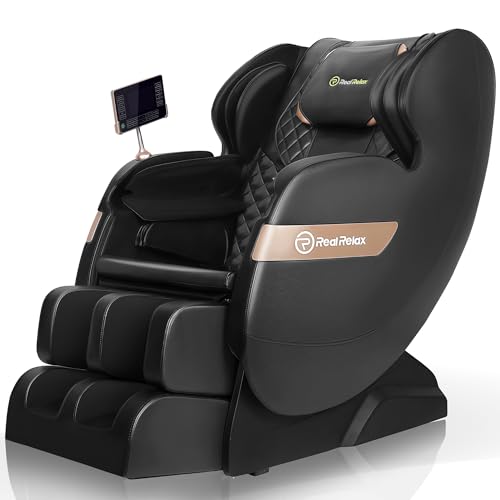
6. Real Relax 2025 Full Body Chair
The Real Relax 2025 offers full-body massage with zero gravity at the most accessible price for a complete chair. Fifty airbags provide compression massage that works independently of roller tracking. Over 2,000 reviews confirm reliability.
Eight massage rollers handle back treatment while airbags address the rest. The zero gravity position reduces pressure on curved spinal segments. Heat therapy targets the lumbar region where many scoliosis patients carry tension.
The space-saving design needs only 3 inches of wall clearance. Bluetooth connectivity provides entertainment during sessions. The price point makes this chair accessible for patients testing whether full-body massage helps their scoliosis.
Price: $620 | Rating: 4.3/5 (2,053 reviews) | Airbags: 50 | Best For: Budget zero gravity with airbags
7. COMFIER Cordless 2D/3D Massage Pad
The COMFIER Cordless Pad switches between 2D and 3D massage modes. The 3D mode adds depth for deeper muscle work while 2D provides gentler surface treatment. This flexibility suits scoliosis patients who need different intensities on different days.
Massage pads avoid the roller tracking problems that full chairs present for curved spines. The pad conforms to whatever chair you sit in, and your body position determines where massage contacts your back. You control contact points through body positioning rather than relying on programmed roller paths.
Cordless operation allows use anywhere without outlet constraints. Heat therapy adds warmth during treatment. Over 1,000 reviews confirm effectiveness and battery performance.
Price: $160 | Rating: 4.2/5 (1,098 reviews) | Type: Cordless Pad | Best For: Avoiding roller tracking issues
8. Snailax Back Massager with Heat
The Snailax Back Massager provides adjustable-zone kneading massage with heat therapy. Over 17,000 reviews confirm its reliability. The massage nodes travel vertically but you control which zones receive treatment.
Zone control lets you focus massage on your tightest areas while skipping sensitive segments. The heat function operates independently for warmth-only sessions. Adjustable straps position the unit on various chair types.
The kneading nodes work through compression rather than following a fixed spinal track. This approach accommodates lateral curvature better than rigid roller systems. The affordable price allows testing before committing to expensive full chairs.
Price: $130 | Rating: 4.4/5 (17,171 reviews) | Type: Massage Pad | Best For: Affordable adjustable-zone massage
9. COMFIER Shiatsu Deep Tissue Massager
The COMFIER Deep Tissue Massager provides the highest-rated massage experience in this category at 4.5 stars. The deep tissue kneading nodes address chronic muscle tension common with scoliosis. Spot massage targets specific areas of tightness.
For more information, check out our guide on Best Massage Chairs for Anxiety and Panic Attacks.
Adjustable intensity ranges from gentle to firm. Start gentle on sensitive areas near curve peaks and increase on chronically tight muscles away from bony prominences. Heat therapy relaxes tissue before deep kneading begins.
The compact design fits most chairs. You position yourself to control where nodes contact your back. This user-directed approach works better for curved spines than automated roller programs.
Price: $116 | Rating: 4.5/5 (1,821 reviews) | Type: Deep Tissue Pad | Best For: Targeted chronic muscle tension
Comparison Table: Massage Devices for Scoliosis
| Product | Price | Type | Depth Control | Airbags | Rating |
|---|---|---|---|---|---|
| Alfine A688 | $4,099 | Full Body 4D+3D | Yes (4D+3D) | Yes | 4.0 |
| Osaki Vibe 4D | $3,999 | Full Body 4D | Yes (4D) | 32-Cell | 4.0 |
| Titan AmaMedic 3D | $1,999 | Full Body 3D | Yes (3D) | Yes | 4.1 |
| KTENTITO | $1,350 | Full Body SL | Limited | Yes | 4.0 |
| VEVOR | $1,000 | Full Body 3D | Yes (3D) | Yes | 4.0 |
| Real Relax 2025 | $620 | Full Body | Limited | 50 Bags | 4.3 |
| COMFIER Cordless Pad | $160 | 2D/3D Pad | Yes (2D/3D) | No | 4.2 |
| Snailax Massager | $130 | Massage Pad | No | No | 4.4 |
| COMFIER Deep Tissue | $116 | Deep Tissue Pad | Adjustable | No | 4.5 |
Using a Massage Chair Safely with Scoliosis
Starting Your First Sessions
Begin with 10-minute sessions at the lowest intensity. Your curved spine may react differently than you expect. Monitor how you feel during and for 24 hours after your first session. Some temporary soreness is normal. Sharp pain or worsening symptoms signal you need to adjust your approach.
Increase duration by 5 minutes per week as your body adapts. Extend intensity gradually based on comfort. Rushing the progression risks soreness that discourages continued use.
Position Experiments
Try different recline angles during early sessions. Zero gravity positioning may provide better roller contact for some curve patterns. Slight upright positioning works better for others. The angle that produces the most comfortable and effective treatment varies with individual curves.
Shift your body slightly left or right to improve roller contact on your spine. Small position changes can dramatically improve how rollers interact with your specific curvature. Find what works and remember it for future sessions.
Target Muscles, Not Bones
Focus massage on the tight muscles surrounding your curve rather than the curved vertebrae themselves. The paraspinal muscles on the concave side hold the most tension. The quadratus lumborum on the overworked side responds well to targeted treatment. These muscles create most of the daily pain scoliosis patients experience.
Asymmetric Treatment
Your body is not symmetrical, and your massage does not need to be either. Spend more time on your tighter side. Use spot massage to target the concave-side muscles that shorten chronically. This focused approach addresses the actual problem rather than treating both sides identically.
Combining with Physical Therapy
Massage works best alongside prescribed scoliosis exercises. Physical therapy strengthens weak muscles while massage releases tight ones. The combination addresses both sides of the muscle imbalance equation. Discuss massage chair use with your physical therapist for coordinated treatment.
When to Avoid Massage Chairs
Recent spinal surgery requires medical clearance before any mechanical massage. Wait until your surgeon specifically approves massage chair use. Severe curves with prominent bony areas may not tolerate roller pressure safely. Conditions causing spinal instability contraindicate mechanical massage entirely.
Consult your spine specialist before starting massage if your curve exceeds 40 degrees, you have had spinal fusion or instrumentation, or you experience neurological symptoms like numbness or tingling.
Massage Pads Versus Full Chairs for Scoliosis
Massage pads offer advantages that full chairs cannot match for scoliosis patients. Pads avoid the fixed roller tracking that causes problems with curved spines. Your body position on the pad determines where massage contacts your back. You control the contact points naturally.
Full chairs provide more comprehensive treatment with zero gravity positioning and airbag compression. The additional features justify higher costs when scoliosis patients find comfortable settings. Testing both approaches before committing helps determine which works better for your specific curve.
Many scoliosis patients use both types. A massage pad handles daily maintenance sessions. A full chair provides deeper weekly treatment. This combination addresses different needs cost-effectively.
Frequently Asked Questions
Can massage chairs make scoliosis worse?
Massage chairs cannot worsen the structural spinal curve. They work on muscles, not bone alignment. However, aggressive massage on sensitive areas can cause temporary pain. Use appropriate intensity and avoid areas that produce sharp discomfort.
What type of massage works best for scoliosis?
Air compression and gentle kneading work best for most scoliosis patients. These methods provide effective muscle relief without the tracking problems that roller systems create on curved spines.
Should I get medical clearance before using a massage chair?
Yes, consult your spine specialist or physical therapist before starting massage chair use. This matters especially for moderate to severe curves, post-surgical spines, or curves with neurological involvement.
How often should scoliosis patients use massage?
Daily sessions of 15 to 20 minutes provide the most consistent muscle tension relief. Adjust frequency and duration based on your individual response. Some patients benefit from twice-daily short sessions.
Do body scanning features work for curved spines?
Body scanning systems assume bilateral symmetry and typically miss lateral curvature. They establish approximate starting positions only. Manual adjustments after scanning provide more accurate targeting for scoliosis users.
Is a 3D or 4D mechanism necessary for scoliosis?
Depth-adjustable mechanisms (3D or 4D) significantly improve comfort for scoliosis patients. The ability to reduce pressure over sensitive curve peaks and increase it on tight muscles makes these mechanisms highly valuable.
Can children with scoliosis use massage chairs?
Consult the child's orthopedic specialist first. Most massage chairs are designed for adult bodies. Children may not fit properly, and growing spines require professional guidance regarding mechanical massage.
What is the best budget option for scoliosis?
The COMFIER Deep Tissue Massager at $116 provides adjustable intensity with targeted treatment. For full chairs, the Real Relax 2025 at $620 offers zero gravity and 50 airbags at the lowest full-chair price.
Do airbags work better than rollers for scoliosis?
Many scoliosis patients find airbag compression more comfortable than roller massage. Airbags compress from the sides without following a spinal track, avoiding the path-mismatch problems rollers create on curved spines.
How do I position myself for the best roller contact?
Shift slightly toward the convex side of your curve. This moves your spine closer to the roller path. Small adjustments of half an inch can significantly improve contact. Experiment during early sessions to find your optimal position.
Will massage help with scoliosis-related breathing restrictions?
Massage can relax the intercostal muscles between ribs, potentially improving rib cage mobility. It does not change the structural rib cage deformity. Some patients report easier breathing after sessions that target the thoracic region.
Can massage replace physical therapy for scoliosis?
No. Physical therapy strengthens weak muscles and teaches corrective exercises. Massage releases tight muscles but does not strengthen weak ones. Both approaches complement each other. Neither replaces the other.
What features matter most for severe scoliosis?
Air compression and heat matter most for severe curves. Roller systems often cause discomfort with significant curvature. Gentle vibration, heat therapy, and compression provide relief without tracking problems.
Should I avoid certain massage techniques with scoliosis?
Avoid intense tapping or percussion directly over prominent curve areas. These techniques apply concentrated force that sensitive bony prominences may not tolerate. Kneading and compression distribute force more safely.
How long until I notice improvement from regular massage?
Most scoliosis patients notice reduced muscle tension within one to two weeks of daily use. Cumulative benefits build over four to eight weeks. Maximum benefit typically develops after consistent use for two to three months.
Can massage help after scoliosis surgery?
Only with surgeon clearance, typically granted 3 to 6 months post-surgery. Avoid the surgical area until fully healed. Massage can help with compensatory muscle tension that develops during recovery. Start extremely gently when approved.
Do massage pads work better than full chairs for scoliosis?
Massage pads avoid roller tracking issues and let you control contact through body positioning. Full chairs offer more features like zero gravity and airbags. Many scoliosis patients find pads more comfortable for daily use.
What should I do if massage causes increased pain?
Stop the session immediately. Reduce intensity for your next attempt. Avoid the specific area that caused pain. If pain persists, consult your healthcare provider. Your curve pattern may require different positioning or technique.
Is zero gravity positioning helpful for scoliosis?
Zero gravity distributes body weight evenly and reduces pressure on individual vertebral segments. Most scoliosis patients find this position more comfortable than upright sitting. It allows better muscle relaxation during massage.
Can I use a massage chair if I wear a scoliosis brace?
Remove your brace before using a massage chair. The brace prevents proper roller and airbag contact with your back. Massage sessions provide a beneficial break from brace wear. Replace your brace after the session ends.
How do I choose between a massage pad and full chair?
Start with a massage pad at $116 to $160 to test whether massage helps your scoliosis. If you experience clear benefits, consider upgrading to a full chair for zero gravity and airbag features. This approach minimizes financial risk.
Will insurance cover a massage chair for scoliosis?
Most insurance plans do not cover massage chairs as durable medical equipment. Some flexible spending accounts or health savings accounts may allow the purchase. Check with your insurance provider and tax advisor for your specific situation.
Can massage correct spinal curvature?
No. Massage cannot change bone position or reverse structural curvature. It addresses the muscle tension and pain that scoliosis creates. Maintain realistic expectations about symptomatic relief rather than structural correction.
What is the difference between S-track and SL-track for scoliosis?
S-track follows the spine from neck to lower back. SL-track extends further under the glutes and thighs. SL-track provides better coverage for scoliosis patients who develop compensatory tension in the gluteal and hip muscles.
Conclusion
Scoliosis patients can benefit significantly from massage when they choose the right equipment and use it properly. The key lies in adjustable depth, manual targeting, and air compression that works regardless of spinal alignment.
For maximum adjustability, the Alfine A688 at $4,099 provides dual 4D and 3D mechanisms with comprehensive controls. The Osaki Vibe 4D at $3,999 offers excellent air compression as an alternative to roller massage.
Mid-range buyers should consider the Titan AmaMedic 3D at $1,999 for solid 3D depth control. The Real Relax 2025 at $620 provides the most affordable full-chair option with 50 airbags.
Massage pads offer a practical starting point. The COMFIER Deep Tissue Massager at $116 delivers targeted relief without tracking problems. Test pads first, then invest in a full chair when you confirm massage helps your specific curve.
Always consult your spine specialist before starting massage therapy. Start gently, target muscles rather than bones, and adapt your approach to your daily symptom levels. With proper selection and use, massage becomes a valuable tool for managing life with scoliosis.